
5 Amazon Products That Grew in July 2026 by Cutting Price
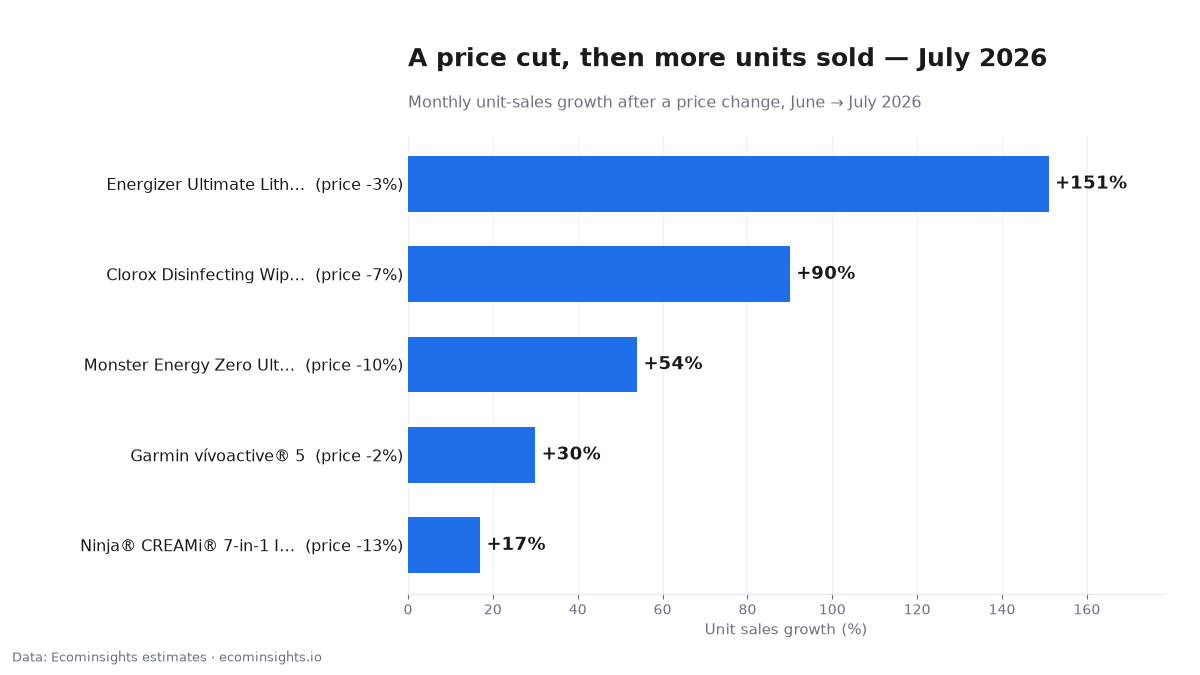
In July 2026, several of Amazon’s biggest sellers grew revenue without launching a single new product. They simply cut the price on a listing they already had. Across cleaning, energy drinks, batteries, wearables, and kitchen gear, a modest price drop of 3–13% lined up with a large jump in unit sales, from +17% to +151%. But the real lesson isn’t “cut price”. It’s when a price cut turns into a volume surge, and when it just gives away margin. Below are five clear examples, a breakdown of why each worked, how to read price elasticity in your own catalog, and how to run a price test without eroding your profit. All sales and revenue figures are Ecominsights estimates from observed marketplace signals, comparing June 2026 to July 2026.
Key takeaways
- Price cuts of 3–13% coincided with unit growth of 17–151% on established listings.
- None of the five launched a new ASIN (the growth came from repricing existing catalog).
- The effect was strongest where a seasonal moment (back-to-school) was already building demand.
- The size of the price cut didn’t predict the size of the response. Elasticity and timing did.
- All figures are Ecominsights estimates, not official brand numbers.
The data at a glance
| Product | Price (June → July) | Unit change | Est. July revenue |
|---|---|---|---|
| Clorox Back to School Disinfecting Wipes (3-pack) | $11.99 → $11.11 (−7%) | +90% | ~$3.6M |
| Monster Energy Zero Ultra (16 oz) | $29.98 → $26.98 (−10%) | +54% | ~$3.1M |
| Garmin vívoactive 5 | $189.99 → $185.97 (−2%) | +30% | ~$2.7M |
| Energizer Ultimate Lithium AA (24-pack) | $36.59 → $35.47 (−3%) | +151% | ~$2.5M |
| Ninja CREAMi (NC301) | $229.00 → $199.99 (−13%) | +17% | ~$2.5M |
Why this pattern is worth studying
Most growth stories on Amazon are about new products, better listings, or bigger ad budgets. This one is quieter and, for most operators, more useful: five established sellers grew meaningfully by changing one number on a listing they already owned. That matters because repricing is the cheapest growth lever there is: no new inventory to source, no launch to fund, no creative to produce. But the five examples also carry a warning written into the data: the biggest price cut (Ninja, −13%) produced the smallest unit lift (+17%), while one of the smallest cuts (Energizer, −3%) produced the largest (+151%). If price cuts worked in a simple, linear way, that couldn’t happen. The rest of this piece is about why it did.
1. Clorox Back to School Disinfecting Wipes: a 7% cut, a 90% unit jump
Clorox’s Back to School Disinfecting Wipes 3-pack moved from an estimated 169,894 units in June to 322,049 in July after the average selling price slipped from $11.99 to $11.11, an estimated $3.6M in July revenue. The timing is the whole story: the cut landed exactly as back-to-school demand for classroom cleaning supplies was ramping, and the product name itself (“Back to School”) tells you the manufacturer was aiming at that window. Price was the trigger, but the season did the heavy lifting: the same 7% cut in a dead month would almost certainly not have doubled units. This is the template for the whole list: a modest cut, applied when demand is already building, compounds instead of just trading margin for volume.
2. Monster Energy Zero Ultra: a 10% cut, 54% more cans
Monster Energy Zero Ultra (16 oz) dropped from $29.98 to $26.98 and sold an estimated 54% more units (roughly 74,249 to 114,664) for an estimated $3.1M month. Energy drinks are a repeat-purchase staple, and that changes the math on a price cut entirely: a lower price doesn’t just win a one-time sale, it can shift which brand a habitual buyer stocks up on for months. A double-digit cut on a staple flavor during peak summer demand is a volume lever, not a margin giveaway: the incremental units, and the repeat purchases behind them, more than compensate for the lower unit price. In consumable categories, elasticity is often high precisely because buyers are price-sensitive on things they buy again and again.
3. Garmin vívoactive 5: a small cut on a high-ticket item
Even a 2% trim mattered at Garmin’s price point. The vívoactive 5 eased from $189.99 to $185.97 and units rose an estimated 30% (about 10,871 to 14,151), an estimated $2.7M in July. This is the counterintuitive one: a barely-visible price change unlocked a large response on a high-ticket wearable. The likely explanation is that at premium price points, a small nominal cut can push a product past a shopper’s mental threshold or make it the best-value option against close competitors, tipping buyers who were already considering it. It’s a reminder that elasticity isn’t about the percentage cut. It’s about where the new price sits relative to the buyer’s decision and the alternatives.
4. Energizer Ultimate Lithium AA: the biggest volume response
Energizer’s Ultimate Lithium AA 24-pack shaved just 3% off price ($36.59 to $35.47) yet units grew an estimated 151% (roughly 25,206 to 63,335) for an estimated $2.5M. This is the most dramatic elasticity on the list, and the smallest cut, which is exactly what makes it instructive. A consumable bought in bulk, with strong seasonal (back-to-school electronics, device restocking) and stock-up behavior, can be extraordinarily price-sensitive: shoppers comparing near-identical multi-packs will jump on the cheaper one, and a 3% edge is enough to win the comparison. When the product is a commodity-like staple and the buyer is comparing on price alone, tiny cuts can produce outsized volume, the opposite of the Ninja case below.
5. Ninja CREAMi: a 13% cut into peak season
The Ninja CREAMi (NC301) fell from $229.00 to $199.99 (through the psychological $200 line) and units rose an estimated 17% (about 10,042 to 11,752), an estimated $2.5M. Note the contrast: the largest cut on the list produced the smallest unit response. That’s what you’d expect for a considered, higher-ticket kitchen purchase: buyers deliberate, the decision isn’t a reflexive price comparison, and demand is less elastic than for a $35 battery multipack. The cut still did real work: crossing the round-number $200 threshold at the start of summer ice-cream season looks like a deliberate demand play, and 17% more units on a $200 appliance is meaningful revenue. But it shows that on considered purchases, you often have to cut more to move less.
Why the size of the cut didn’t predict the response
Line the five up and the pattern is clear: the response tracked elasticity and timing, not the depth of the discount. Commodity-like consumables bought on price comparison (Energizer, Clorox, Monster) responded hugely to small or moderate cuts, especially with a season behind them. A considered, higher-ticket purchase (Ninja) needed a big cut to move modestly. And a premium item near a decision threshold (Garmin) responded to a tiny cut because of where the new price landed, not how big the cut was. The practical takeaway: before you discount, ask how price-sensitive your buyer actually is for this product, because the same percentage cut can 2.5x your units or barely move them.
How to read price elasticity in your own catalog
You can diagnose elasticity from your own history without any theory. Pull a SKU’s monthly price and unit sales side by side over the last year and look at the months where price moved: did units respond sharply, mildly, or not at all? A product where small price changes swing volume a lot is elastic, a candidate for a strategic cut when demand is building. A product where units barely react to price is inelastic: cutting mostly donates margin, and you’re better off competing on availability, content, or timing. Doing this across your catalog sorts your SKUs into “price is a lever” and “price is not the lever,” which is the single most useful thing to know before any promotion.
Seasonality: the multiplier on every cut
The thread running through the strongest results is that a price cut and a rising season compound each other. Clorox and Energizer both rode back-to-school; Monster and Ninja rode summer. A cut applied into building demand catches buyers who were already going to shop the category, so you win a larger share of a growing pie. The same cut in an off-season simply lowers your margin on the buyers you’d have gotten anyway. That’s why timing matters as much as the number: the best price moves are scheduled against the category’s demand calendar, not made reactively when sales feel slow. Knowing when your category peaks (from its own 12-month history) tells you when a cut will multiply rather than just subtract.
When a price cut backfires
It’s worth being blunt about the downside, because “cut price to grow” is dangerous advice taken literally. A cut backfires when the product is inelastic (you lower margin without meaningfully lifting units, the risk on considered, higher-ticket items), when there’s no demand behind it (an off-season cut just trains buyers to wait for discounts), or when it starts a price war on a crowded listing (competitors match, everyone’s margin falls, nobody gains lasting share). It can also erode a premium brand’s positioning if discounting becomes a habit. The five wins here worked because each cut hit an elastic product with a season behind it. Remove either condition and the same move can quietly destroy profit.
How to run a price test without giving away margin
Treat repricing as an experiment, not a leap. Pick a hero SKU you’ve identified as elastic, choose a moment when its category demand is building, and make a defined, reversible cut, not a scattergun discount across the catalog. Watch units and total revenue (not just margin per unit) for a set window, and compare against the same SKU’s prior months and, ideally, the same month last year to strip out seasonality. If units lift enough that total contribution rises, you’ve found a lever; if margin falls without a real volume response, revert and mark the SKU inelastic. The discipline is measuring total contribution over a fixed window and being willing to reverse. That’s how you capture the Energizer-style wins while avoiding the Ninja-style disappointments.
What operators can take from this
The lesson is not “cut price.” A small cut only produces a large unit lift when demand is already stacking up behind a moment on the calendar and the product is genuinely price-elastic. Before funding a new ASIN for next quarter, it’s worth testing what a deliberate, well-timed price move on an existing hero SKU does. The elasticity is often hiding in a product you already sell, and unlocking it costs nothing to source. Just as important, know which of your products are the Ninja and which are the Energizer, so you spend your discounts where they multiply and defend margin where they wouldn’t.
What to do next
Pick your top few SKUs, chart price against units over the last 12 months, and label each elastic or inelastic. For the elastic ones, plan a reversible price test into the next moment your category demand builds, and measure total contribution over a fixed window. You can check any product’s price-and-sales history on Ecominsights, free to start.
FAQ
Are these official brand sales figures? No. All unit and revenue figures are Ecominsights estimates based on observed Amazon marketplace signals, comparing June 2026 to July 2026.
Did any of these brands launch new products to grow? Not in these cases. Each example is the same existing listing at a lower price: growth came from repricing, not new ASINs.
Does cutting price always increase revenue? No. It worked here because demand was already building and the products were price-elastic; the same cut on an inelastic product or in an off-season simply lowers margin.
Why did the biggest cut (Ninja) produce the smallest lift? Considered, higher-ticket purchases are less price-elastic than commodity-like consumables, so they need a larger cut to move fewer extra units, the opposite of the Energizer battery multipack.
How do I tell if my product is price-elastic? Compare its monthly price and unit sales over the last year; if small price changes swing volume a lot, it’s elastic and a candidate for a strategic cut. If units barely react, it isn’t.
When is the best time to cut price? Into building category demand, so the cut catches shoppers already entering the category (not in an off-season, when it mostly trains buyers to wait for discounts).
How can I check a product’s price and sales trend myself? You can look up any brand, product, or keyword and see how its monthly sales and pricing have trended on Ecominsights (free to start).
Methodology: figures are Ecominsights estimates derived from observed Amazon marketplace signals, comparing the June 2026 and July 2026 reporting periods. Estimates, not official figures. Last updated: September 2026.
Data: Ecominsights, monthly Amazon sales history on 5M+ products. See how any product has trended, free at Ecominsights.
We deliver the most actionable insights for Amazon sellers, brands, agencies, and investors; revealing hidden opportunities, competitor weaknesses, and the data that actually moves revenue. Make every decision backed by real marketplace signals, not assumptions.
No credit card required • Get set up in under 2 minutes
⭐⭐⭐⭐⭐ Trusted by 2,000+ Sellers