
The Fastest-Growing Amazon Products in July 2026
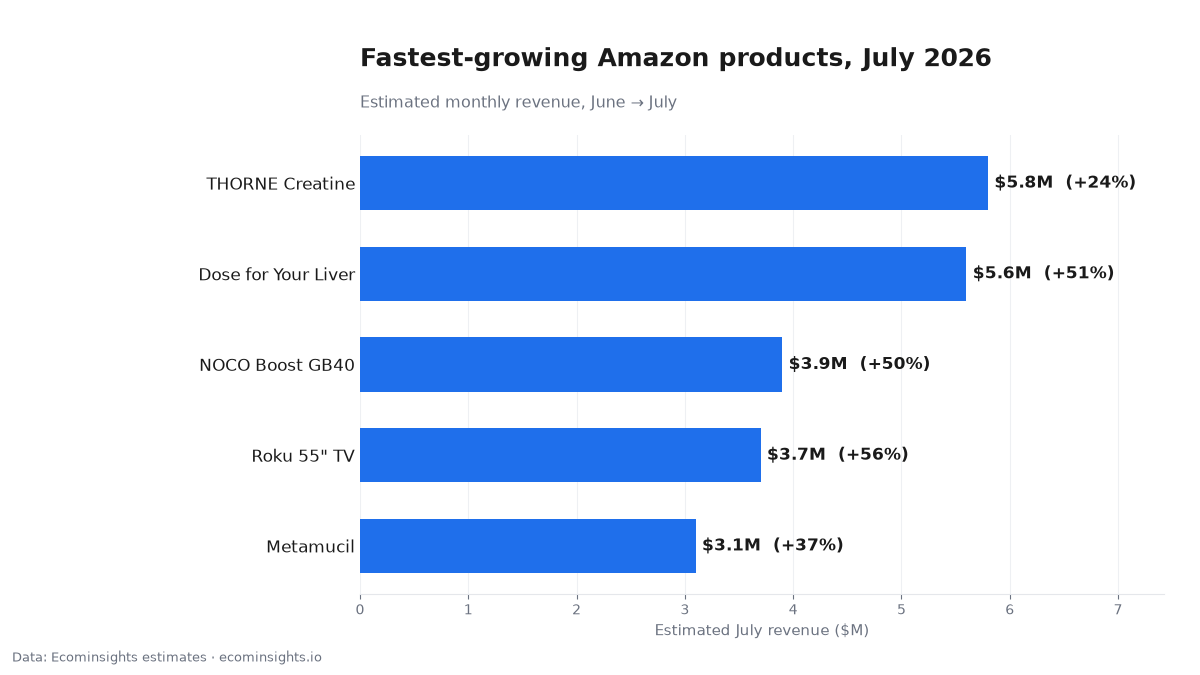
In July 2026, a handful of established Amazon products posted standout month-over-month growth, led by THORNE Creatine at an estimated $5.8M (+24%) and a liver-support supplement that jumped 51% to an estimated $5.6M. The common thread is important: these are existing listings gaining momentum, not new launches. That makes them a lesson in reading demand on products you (or your competitors) already have, rather than a hunt for the next big thing. Below is the full list, a read of what likely drove each move, and how to use “quietly accelerating” SKUs to decide where to put inventory and ad spend. All figures are Ecominsights estimates from observed marketplace signals, comparing June to July 2026.
Key takeaways
- THORNE Creatine reached an estimated $5.8M (+24%), the largest by revenue.
- Dose for Your Liver grew fastest in the group at +51% ($3.7M → $5.6M).
- A NOCO jump-starter (+50%) and a Roku TV (+56%) rode summer demand.
- Supplements dominate the list, a recurring theme in the data.
- All figures are Ecominsights estimates, not official sales numbers.
The data at a glance
| Product | Est. revenue (June → July) | Change |
|---|---|---|
| THORNE Creatine | $4.6M → $5.8M | +24% |
| Dose for Your Liver | $3.7M → $5.6M | +51% |
| NOCO Boost GB40 | $2.6M → $3.9M | +50% |
| Roku 55″ Select TV | $2.4M → $3.7M | +56% |
| Metamucil 4-in-1 | $2.3M → $3.1M | +37% |
THORNE Creatine: the biggest by revenue
THORNE Creatine grew from an estimated $4.6M to $5.8M, a 24% lift and the largest single-product revenue on the list. Creatine has moved from a niche bodybuilding supplement to a mainstream wellness staple, and a steady, moderate climb on an already-large base is exactly what durable demand looks like, not a viral spike, but a product compounding as its category broadens. For operators, the read is that health-and-wellness staples with repeat-purchase behavior can keep growing well past the point where they look “mature,” and they’re worth defending with inventory and ad coverage rather than treating as done.
Dose for Your Liver: the fastest climber
The liver-support supplement “Dose for Your Liver” posted the sharpest gain in the group, up an estimated 51% from $3.7M to $5.6M. A jump that size on a multi-million base usually reflects a specific demand driver, a wave of interest in a wellness trend, stronger content or influencer attention, or a promotional push landing in July. Whatever the trigger, the pattern to notice is a functional-health product accelerating fast; these can climb quickly as a trend catches, and just as quickly cool, so the smart move is to ride the wave while confirming it’s more than a one-month blip.
NOCO Boost and Roku: seasonal electronics
Two electronics products round out the leaders and both fit the summer calendar. The NOCO Boost GB40 jump-starter grew an estimated 50% ($2.6M → $3.9M), consistent with summer road-trip and travel demand, exactly when drivers think about dead batteries. The Roku 55″ Select TV rose 56% ($2.4M → $3.7M), fitting home-entertainment buying during the season. Both are existing products, well-timed rather than newly launched, and both are reminders that a lot of “growth” on Amazon is really seasonality showing up on schedule, predictable if you’re watching the calendar.
Metamucil: steady health-staple demand
Metamucil 4-in-1 grew an estimated 37% ($2.3M → $3.1M), the second supplement in the top five and another data point in a clear pattern: health and wellness keeps surfacing in July’s movers. Like creatine, it’s a repeat-purchase staple whose growth reflects broad, habitual demand rather than a fad. When two of your top five fastest-growing products are established supplements, that’s a signal about where consistent Amazon demand lives, and where competition for it is intensifying.
Why supplements keep showing up
Health and wellness appears repeatedly in this data for structural reasons: supplements are consumable and repeat-purchase, they benefit from subscribe-and-save, and the category has been broadening from niche to mainstream for years. That combination produces exactly the pattern seen here, several supplements growing steadily on large bases, plus the occasional functional-health product spiking on a trend. For sellers, the takeaway isn’t “sell supplements”; it’s that consumable, habitual categories generate the most durable Amazon demand, and that the competition (and ad costs) there rise accordingly.
Why the whole list is health, wellness, and seasonal goods
Step back and the composition of the list is itself the insight: three of the five are supplements or health staples, and the other two are seasonal electronics. That isn’t a coincidence of one month. It’s the two engines of durable Amazon demand showing up together. Consumable health products grow because people reorder them, and the category has been broadening from gym-goers to the general public for years. Seasonal goods grow because the calendar reliably pulls demand forward. If you’re deciding where to compete, a list dominated by these two profiles is a map: repeat-purchase consumables for steady compounding demand, well-timed seasonal products for predictable surges. The categories that don’t appear (one-off, non-repeat purchases) are quietly telling you where growth is harder to sustain.
New launch vs. existing listing: the real lesson
The most useful fact about this list is what it isn’t: none of these are new launches. Every one is an existing listing that gained momentum. That reframes where sellers should look for growth, not always toward the next new product, but toward the SKUs already in the catalog that are quietly accelerating. A product growing 30–50% on demand you already have is cheaper and lower-risk to double down on than a launch, because the demand is proven and the listing is established. Before you fund something new, check what’s already climbing.
How to read product-level growth
Two cautions. First, weigh the base: a 56% jump on a $2.4M product (Roku) is more volatile than a 24% climb on a $4.6M one (THORNE), so treat the biggest percentage as a flag to investigate, not automatically the strongest business. Second, separate seasonal from structural: the NOCO and Roku moves are calendar-driven and will likely normalize, while the supplement growth looks more durable. Comparing a product to the same month last year is the cleanest way to tell which kind of growth you’re looking at.
How to spot an accelerating SKU in your own catalog
The practical version of this list is run on your own products. Once a month, pull the month-by-month estimate for every SKU you sell and sort by percentage change. The ones climbing 20–50% that you haven’t been actively promoting are the important finds. They’re telling you demand is rising on its own, which is the cheapest growth there is. Cross-check each against its category to confirm the whole space isn’t simply seasonal, and against your stock levels to make sure a rising SKU isn’t about to sell out. An accelerating product you didn’t plan for is an opportunity only if you notice it before it stocks out or before a competitor piles into the same demand.
Inventory and ad implications of a rising SKU
A product growing 30–50% changes two decisions immediately. Inventory: your reorder point should move up to match the new run rate, because a rising SKU that goes out of stock hands its momentum (and its Buy Box) to a competitor at the worst possible time. Ads: rising organic demand is usually the cheapest moment to add sponsored spend, because you’re amplifying a wave rather than manufacturing one, so your ACoS on that SKU tends to be favorable. The mistake is treating a rising product the same as a flat one; growth is a signal to lean in on both stock and spend, deliberately, while the demand is there.
Turning this into a monthly habit
Make the review recurring. Each month, flag your own accelerating SKUs, tag each as seasonal or structural, and note one action: reorder, add ad spend, or hold. Then scan your category’s fastest-growing products the same way to see where demand is heading around you. Over a few cycles you build a rhythm: you catch your own risers early, you see competitors’ risers before they’re obvious, and you stop being surprised by stockouts on exactly the products you should have leaned into. The five products above are just this month’s public example of a pattern you can track privately on your own catalog every month.
What operators can take from this
The fastest growers here didn’t relaunch. They rode demand on listings they already had. So watch which of your own SKUs are quietly accelerating before you invest in something new, and make sure the accelerating ones don’t go out of stock at the worst possible moment. If you sell in health and wellness, expect steady demand and steady competition; if you sell seasonal electronics, plan inventory and bids a month ahead of the wave rather than reacting to it. And whatever you sell, resist the instinct to read a single hot month as a trend. The products here earned their place by growing on top of demand that was already there, which is a far more reliable foundation than a one-off spike. The pattern in this data is a template you can apply to your own catalog every month: find what’s quietly accelerating, confirm it’s real, and put your stock and spend behind it before anyone else notices.
What to do next
Pull the month-by-month estimate for your top SKUs and flag any growing 20%+ that you haven’t been actively supporting. Those are your cheapest growth. Then check the same for your category’s leaders to see where demand is heading. You can see any product’s monthly estimated revenue trend on Ecominsights, free to start. Make it a monthly habit, and the quietly accelerating SKUs will surface while you can still act on them cheaply.
FAQ
Are these official sales numbers? No. They’re Ecominsights estimates from observed marketplace signals, comparing June to July 2026, best used for direction and relative size.
Did any of these launch new products? No, these are all existing listings gaining momentum, which is the main lesson of the list.
Why are supplements so common here? They’re consumable, repeat-purchase, and benefit from subscribe-and-save, so demand compounds, and the category has been going mainstream for years.
Is the growth seasonal? Partly: the NOCO jump-starter and Roku TV are clearly seasonal; the supplement growth looks more durable. Compare to last year’s same month to be sure.
Should I chase the biggest percentage mover? Treat it as a flag to investigate, not a verdict: a big jump on a smaller base is more volatile than steady growth on a large one.
How do I track a product’s trend? See any product’s month-by-month estimate on Ecominsights, free to start, with 12 months of history.
Methodology: Ecominsights estimates from observed marketplace signals, comparing June and July 2026. Estimates, not official figures. Last updated: October 2026.
Data: Ecominsights, Amazon market intelligence on 5M+ products. Ecominsights.
We deliver the most actionable insights for Amazon sellers, brands, agencies, and investors; revealing hidden opportunities, competitor weaknesses, and the data that actually moves revenue. Make every decision backed by real marketplace signals, not assumptions.
No credit card required • Get set up in under 2 minutes
⭐⭐⭐⭐⭐ Trusted by 2,000+ Sellers