
How Amazon Agencies Find Brands Worth Pitching (Before Competitors Do)
The fastest way for an Amazon agency to find brands worth pitching is to work backwards from brand-level revenue and its 12-month trajectory (filtering for sizable brands whose sales are sliding) instead of hunting for products. A brand losing ground on Amazon has both a budget and a problem, which is the exact definition of a warm lead. This guide walks the full prospecting workflow: the filter that surfaces those leads, how to read a brand’s trajectory, how to turn a decline into an opening, and how the same data powers your pitch deck, your audits, and your monthly client reports. Every figure below is an Ecominsights estimate from observed marketplace signals (June–July 2026), useful for direction and cross-checking rather than as an official number.
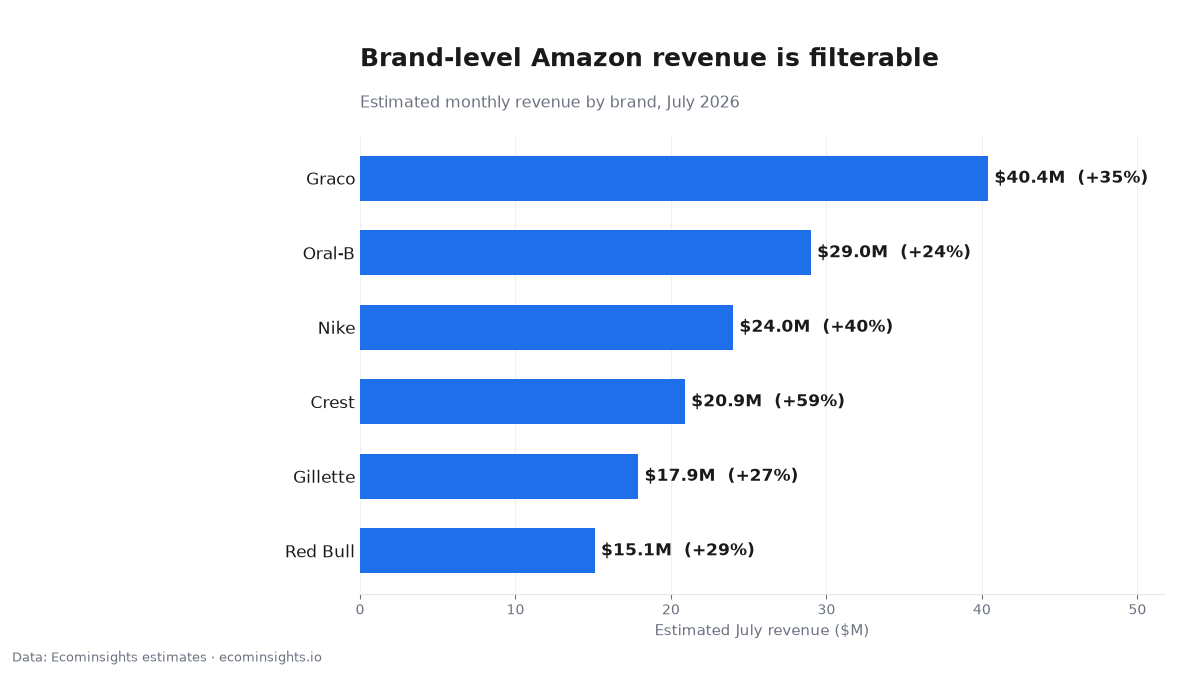
| Brand | Est. revenue, July 2026 | Change from June 2026 |
|---|---|---|
| Graco | $40.4M | +35% |
| Oral-B | $29.0M | +24% |
| Nike | $24.0M | +40% |
| Crest | $20.9M | +59% |
| Gillette | $17.9M | +27% |
| Red Bull | $15.1M | +29% |
Why product-research tools fail agencies at prospecting
Helium 10 and Jungle Scout are built to answer a product question: which ASIN has demand and beatable competition. That is the right tool for a seller choosing what to launch, and the wrong tool for an agency choosing whom to sell to. Agencies don’t sign products; they sign brands. When your prospecting tool only thinks in ASINs, you end up reverse-engineering brands from products one listing at a time, slow, incomplete, and blind to the thing that actually signals opportunity: whether a brand’s total Amazon revenue is rising or falling. A product tool will happily show you a hot supplement listing, but it won’t tell you that the brand behind it has quietly given back a third of its revenue since spring. That gap is structural, not cosmetic, which is why brand-level historical data changes how a business-development team spends its week.
The brand-centric question that actually matters
Reframe prospecting around one question: which brands are big enough to afford you, and which direction is their Amazon revenue heading? Size tells you they can pay; direction tells you whether they have a reason to. A brand growing 40% rarely feels urgency to hire help: things are working, and a new agency is a risk. A brand of the same size that has given back 30% over two quarters is often actively looking, and usually before it has written a formal brief or posted an RFP. That pre-RFP window is the whole game: it’s where you win the account on a warm call instead of losing it in a five-way bake-off. Answering the question requires brand-level revenue with history, not a snapshot of today’s bestsellers.
The prospecting filter that surfaces warm leads
The highest-yield filter is simple: brands doing an estimated $1–5M per year whose revenue has dropped roughly 30% over the last six months. The revenue band screens for businesses large enough to have a real marketing budget but small enough not to already have a big agency on retainer: the sub-$1M brands often can’t pay, and the $10M+ brands usually already have someone. The decline screens for pain. Layer in category if you specialize (an agency strong in supplements should filter within supplements so its pitch is credible) and you have a shortlist of companies with money, a problem, and a reason to take your call this quarter. Because the data is historical, you see the slide forming while it’s still a private worry, not after it becomes a public tender.
A worked example
Say the filter returns a supplement brand estimated at $2.4M/year whose monthly revenue fell from roughly $260K to $180K over six months while its category held flat. That last detail is the one that matters: the category didn’t sink, so this is a brand-specific problem (a lost buy box, ranking slippage, a pricing misstep, or ad spend pulled back) not a market you can’t fix. Contrast that with a brand down the same 30% inside a category that’s down 28%: there, the brand is just riding the tide, and there’s little for you to “fix.” The first brand is a call worth making today; the second is one to note and skip. You already know the shape of the problem before you dial, which is exactly the edge that turns a cold list into a warm one.
How to read a brand’s 12-month trajectory
The trajectory tells you which pitch to bring. A steady, gentle decline suggests eroding fundamentals (ranking, reviews, competitors quietly taking share) and favors a full-funnel audit and a retainer. A sharp single-month drop points to a specific event (a suspension, a stockout, a buy-box loss to a hijacker) and favors a targeted rescue offer you can scope in a week. A sawtooth pattern of spikes and crashes usually means inventory or ad-budget volatility, where ongoing management is the obvious fix. Reading the shape before the call lets you lead with the right diagnosis instead of a generic “we do Amazon” intro, and it signals to the founder that you did your homework.
Turning a declining brand into a warm outreach
Cold outreach converts when it proves you already understand the prospect. Instead of “we help brands grow on Amazon,” open with the observation: their estimated monthly revenue has fallen X% since [month], while their category has not. Name the most likely lever and offer a short, specific audit: “twenty minutes, and I’ll show you where the revenue went.” You are not selling a service in the abstract; you are showing you noticed a problem they may not have fully quantified yet, framed as an estimate rather than a claim on their internal numbers. That specificity is what separates a reply from the trash folder, and it sets a tone of competence before the first call.
Walk into the sales call with proof
Most agency decks lead with logos and process. Lead instead with the prospect’s own 12-month revenue chart. Showing a founder exactly what happened to their Amazon sales (and when) reframes the conversation from “why you” to “what do we do about this.” Proof compresses the trust-building phase that normally takes several calls into one, because the data does the persuading and you’re no longer just another vendor making claims. It also sets up the audit as the natural next step rather than a hard upsell: once a founder is staring at the dip, the audit sells itself.
Building the target list, step by step
1) Set your revenue band and decline threshold. 2) Filter to your category strengths so your pitch is credible and your case studies are relevant. 3) Pull each candidate’s 12-month trajectory and tag the pattern (steady decline, event drop, volatility). 4) Cross-check that the category itself isn’t simply seasonal, so you don’t mistake a normal off-season for a brand in trouble. 5) Rank by fit and urgency, and hand your BD person a list where every row comes with a reason to reach out and a first-line hook. What used to take an analyst a week of manual ASIN spelunking becomes an afternoon, and the list is better, because it’s built on the metric that actually predicts a sale.
Using keyword CPC trends in your PPC strategy decks
Prospecting gets the meeting; a sharp strategy deck wins the retainer. Twelve months of keyword search-volume and CPC trends let you show a prospect exactly when their category’s ad costs spike and soften, so your proposed bidding calendar looks like informed strategy rather than guesswork. “We’ll raise bids here and pull back here, based on last year’s CPC pattern in your category” is far more convincing than a flat monthly budget number, and it gives the founder a concrete reason to believe your management will beat their in-house effort. It also quietly justifies the retainer: you’re selling judgment informed by data, not hours.
Reusing the data for audits and monthly reports
The same brand- and category-level history that found the lead also fills your recurring deliverables. Competitive audits become faster because the market context is already at hand. You’re not rebuilding it per client. Monthly client reports gain a competitor-and-category view most agencies can’t produce without an expensive enterprise data contract, which makes your reporting feel a tier above the competition. That turns the tool from a one-time prospecting trick into part of your delivery process, and it’s why agency accounts tend to be multi-seat and low-churn: once the data is wired into how you sell and how you report, it’s hard to rip out.
Common prospecting mistakes to avoid
Don’t pitch brands whose whole category is down. That’s a market problem you can’t fully solve, and it reads as if you didn’t check. Don’t mistake seasonality for decline; a swimwear brand “down 40%” in September is not a lead, it’s a calendar. Don’t over-rely on today’s rank, which hides both volume and direction: a brand can rank well and still be sliding. Don’t open with your capabilities; open with their number. And don’t treat the estimate as gospel in the pitch. Frame it as “our data suggests,” which is both honest and disarming. Each of these is avoidable once you’re reading brand-level history instead of product snapshots.
What to do next
Pick one category you win in, set the $1–5M band with a 30% six-month decline filter, and build a 20-brand list this week. For each, note the trajectory pattern and the likely lever, then send five specific, proof-led outreaches referencing the brand’s own chart. Track which pattern converts best and tighten the filter next month. You can run this exact workflow (brand revenue history, seller rollups, and keyword CPC trends) on Ecominsights, free to start.
FAQ
Can I filter Amazon brands by revenue band and growth? Yes, by revenue range and 12-month trajectory, which is how agencies build target lists of brands that can pay and have a reason to hire.
Are the revenue figures official? No. They are Ecominsights estimates from observed marketplace signals, useful for spotting direction and cross-checking a prospect’s claims, not for quoting as their audited numbers.
How is this different from Helium 10 or Jungle Scout? Those are product-centric and excellent for ASIN research. This is brand-centric with history, built for finding and pitching clients, not for choosing which product to launch.
Does it help with PPC proposals? Yes, 12 months of keyword search-volume and CPC trends support a data-backed bidding calendar in your strategy decks.
Can I use it for monthly client reporting? Yes, the same brand and category history feeds competitive audits and recurring reports, giving clients a market view most agencies can’t produce.
How far back does the history go? Twelve months of monthly data, on every plan including the free tier.
What revenue band should I target? A good default is $1–5M/year: big enough to afford a retainer, small enough not to already have a large agency locked in.
Methodology: Ecominsights estimates from observed marketplace signals; brand figures aggregate a brand’s tracked products, comparing June and July 2026. Estimates, not official figures. Last updated: September 2026.
Data: Ecominsights, Amazon market intelligence on 5M+ products. Ecominsights.
We deliver the most actionable insights for Amazon sellers, brands, agencies, and investors; revealing hidden opportunities, competitor weaknesses, and the data that actually moves revenue. Make every decision backed by real marketplace signals, not assumptions.
No credit card required • Get set up in under 2 minutes
⭐⭐⭐⭐⭐ Trusted by 2,000+ Sellers