
Should You Sell on Amazon? How to Size the Opportunity First
Before a DTC brand launches on Amazon, size the category and see who dominates it: category and brand revenue history tell you the realistic ceiling before you commit a dollar to inventory or ads. Shopify, Walmart, and TikTok Shop brands weighing an Amazon launch usually ask “should we be on Amazon?” when the better first question is “how big is the opportunity, and who already owns it?” Guessing wastes a launch (inventory, ad spend, and months of focus) on a category that turns out too small, too dominated, or already shrinking. This guide walks through sizing the opportunity properly: measuring the category, reading its direction, gauging concentration, and estimating a realistic ceiling before you build. All figures referenced are Ecominsights estimates from observed marketplace signals (June–July 2026).
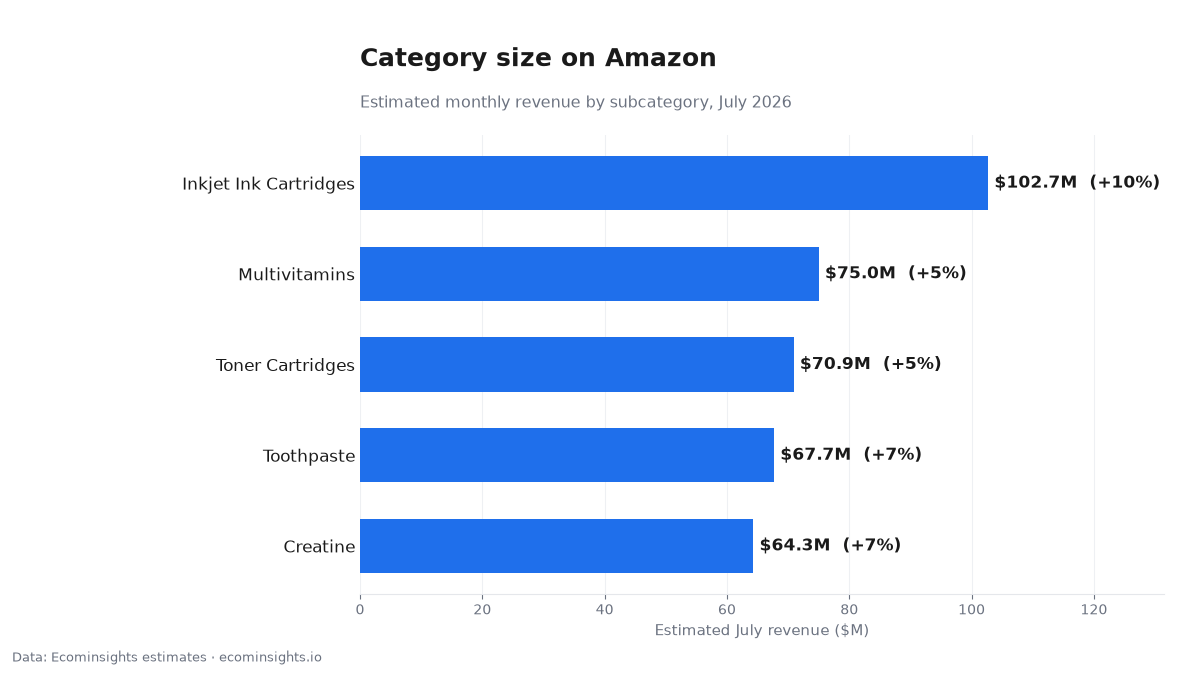
| Subcategory | Est. revenue, July 2026 | Change from June 2026 |
|---|---|---|
| Inkjet Ink Cartridges | $102.7M | +10% |
| Multivitamins | $75.0M | +5% |
| Toner Cartridges | $70.9M | +5% |
| Toothpaste | $67.7M | +7% |
| Creatine | $64.3M | +7% |
Why “should we sell on Amazon?” is the wrong first question
The instinct for a successful DTC brand is to treat Amazon as a yes/no decision, another channel to switch on. But Amazon is not one opportunity; it’s thousands of category-specific opportunities that range from enormous to not worth the effort. Your brand might dominate a niche on Shopify that’s tiny on Amazon, or sit in a category where a couple of entrenched giants take nearly all the revenue and a newcomer’s realistic ceiling is small. The right first question is quantitative: how big is my category on Amazon, which direction is it heading, and how concentrated is it? Answer that, and “should we launch” mostly answers itself, with a number attached instead of a hunch.
How big, and growing or shrinking?
Category revenue history answers the size question and the direction question at once, and both matter. A category worth an estimated $60M a month that’s still climbing is a very different bet from one worth the same today but flat or declining: the first is a rising tide you can grow into, the second is a mature or shrinking space where you’d be fighting for a fixed or falling pie. Twelve months of category revenue shows you the level and the trajectory together, so you can distinguish “big and growing” (launch with confidence) from “big but fading” (proceed carefully) from “small” (maybe not worth the launch effort at all). Size without direction is only half the picture.
Who already dominates?
Brand-level revenue within the category shows who owns it and how concentrated it is, the single biggest factor in your realistic ceiling. A category where the top brand takes the lion’s share and a few others split the rest leaves little oxygen for a newcomer, no matter how strong your DTC brand is. A fragmented category where revenue is spread across many mid-sized brands is far friendlier: it means share is winnable and no incumbent is impossible to dislodge. Before you launch, look at the top ten brands’ estimated revenue and ask how much room is actually left. That concentration read is what turns a fantasy ceiling into a realistic one.
Estimating a realistic revenue ceiling
Put the pieces together and you can estimate a sober ceiling rather than a hopeful one. Take the category’s total, look at how revenue is distributed across the existing brands, and place your brand honestly in that distribution: a strong but new entrant typically lands in the mid-pack, not at the top, in year one. That gives you a defensible revenue range to plan against, which is exactly what you need to decide whether the launch clears your bar. A realistic ceiling protects you from the two expensive errors: over-investing in a category that can’t return it, and under-investing in one where you’ve badly underestimated the room to grow.
A worked example
Suppose your DTC brand sells premium water bottles and you’re weighing Amazon. You pull the drinkware category: it’s large and, going by summer movers, actively growing. But you also see one or two brands taking a big share and a long tail of mid-sized competitors. The read: the category is big enough and rising (good), but concentrated enough at the top that your realistic year-one ceiling is a mid-pack position, not category leadership. That’s still potentially a strong launch, but now you can size inventory and ad budget to a mid-pack outcome, set internal expectations honestly, and decide whether that return justifies the effort, all before spending. Same data, a launch plan grounded in numbers instead of optimism.
Reading your category against your DTC strengths
Sizing isn’t only about the category. It’s about the fit between the category and what your brand already does well. If your DTC success comes from a premium position and strong branding, a commoditized Amazon category competing purely on price may not reward your strengths, even if it’s large. If your edge is a differentiated product in an underserved niche, a fragmented category with no clear premium leader is where that edge travels best. Use the brand-level data to see whether the category has room for your kind of brand, not just for another entrant. The best Amazon launches extend an existing advantage into a category ready to reward it.
Amazon vs. your existing channels: what actually changes
It helps to be clear-eyed about how Amazon differs from the DTC channels you already run. On your own Shopify store you own the customer relationship, the data, and the merchandising; on Amazon you’re competing inside someone else’s marketplace, where the Buy Box, reviews, and ad placement drive sales and the customer is largely Amazon’s. That changes what “winning” looks like and which of your strengths carry over. Sizing the category tells you whether the opportunity is big enough to justify operating under those different rules, and brand concentration tells you whether your differentiation can cut through in an environment that often pushes toward price competition. Going in with eyes open about the trade-offs, backed by the numbers, beats treating Amazon as just another storefront to switch on.
How to test before a full launch
Sizing the opportunity also lets you design a smart test rather than an all-in bet. If the category is attractive but concentrated, you might launch a focused subset of your catalog (the SKUs where your differentiation is strongest) rather than your whole line, and measure whether you can win the mid-pack position the data suggests is realistic. The category and brand history gives you the benchmark to judge the test against: you know roughly what a mid-pack brand does in the space, so you can tell quickly whether you’re tracking to that or falling short. A sized, benchmarked test turns “did Amazon work?” into a measurable question with a clear answer, and limits what a wrong guess can cost.
Reading seasonality before you commit
Category size can mislead if you measure it at the wrong point in the year. A category that looks enormous in its peak season may be modest the rest of the year, and launching on the strength of a seasonal peak is how DTC brands over-commit inventory. Look at the category’s full 12-month shape, not just the current month: is the demand steady year-round, or does it spike and fade? A steady category supports a confident, evergreen launch; a strongly seasonal one calls for timing your entry to the build-up and sizing inventory to the season, not the annual total. Knowing the shape before you commit is what keeps a seasonal category from turning a strong launch into a warehouse full of off-season stock.
Sizing is a one-time research need
Here’s the pragmatic part: sizing the opportunity is a one-time research task, not an ongoing subscription need. You need the category and brand data intensely for the weeks you’re making the launch decision, and far less once you’ve committed. That means a short, inexpensive research window (even a single month of access) can cover the entire sizing exercise: measure the category, read the direction, gauge concentration, estimate the ceiling, and decide. Compared to the cost of a misjudged launch (inventory, ads, and months of team focus), the research spend to size it properly is trivial. It’s the cheapest insurance a DTC brand can buy before betting on a new channel.
Common mistakes DTC brands make launching on Amazon
Three recur. Assuming DTC success transfers directly: a category that’s huge for you elsewhere can be small or brutally concentrated on Amazon. Ignoring direction, launching into a category that’s large today but quietly declining. And skipping the concentration check, setting revenue expectations as if the top spot is available when a couple of incumbents already own most of the category. Each of these is visible before launch in category and brand history, and each is expensive to learn after you’ve committed inventory and ad spend. Sizing first is how you avoid all three.
Where Ecominsights fits
Category and brand revenue history sizes your Amazon opportunity before you spend on inventory or ads, a one-time research need that a short, inexpensive window covers. You use it to measure the category, read its direction, see who dominates and how concentrated the space is, and estimate a realistic ceiling for your brand. It doesn’t replace the operational tooling you’ll add once you launch; it makes sure the launch itself is a considered bet on a category sized to your ambitions, framed throughout as estimates from observed marketplace signals, the right tool for a directional, go/no-go decision.
What to do next
Before you commit to an Amazon launch, pull your category’s 12-month revenue and its top brands, then estimate your realistic ceiling from where your brand would honestly sit in that distribution. Decide against a number, not a hunch. You can size any category and see who dominates it on Ecominsights, enough to make the call before you spend.
FAQ
Can I size a category before launching? Yes, category revenue and its 12-month direction tell you how big the opportunity is and whether it’s growing.
Can I see who dominates the category? Yes, brand-level revenue within the category shows who owns it and how concentrated it is, which drives your realistic ceiling.
Why does concentration matter so much? A category owned by one or two giants leaves little room for a newcomer; a fragmented one is far friendlier to a new entrant.
Does my DTC success transfer to Amazon? Not automatically. A category that’s big for you elsewhere can be small or brutally concentrated on Amazon, which is exactly why you size it first.
Do I need an ongoing subscription to size a launch? No, sizing is a one-time research need a short, inexpensive window covers; ongoing tooling comes after you launch.
Are the figures official? No. They’re Ecominsights estimates from observed marketplace signals, best used for a directional, go/no-go launch decision.
Methodology: Ecominsights estimates from observed marketplace signals; brand/category figures aggregate tracked products, June–July 2026. Estimates, not official figures. Last updated: October 2026.
Data: Ecominsights, Amazon market intelligence on 5M+ products. Ecominsights.
We deliver the most actionable insights for Amazon sellers, brands, agencies, and investors; revealing hidden opportunities, competitor weaknesses, and the data that actually moves revenue. Make every decision backed by real marketplace signals, not assumptions.
No credit card required • Get set up in under 2 minutes
⭐⭐⭐⭐⭐ Trusted by 2,000+ Sellers